Kai's instrument, copied out before I left — their trust in us, forty years of it, the axis in decades. He asked me not to hope at the small rise on the right. I hope at it anyway.
Evening 1Vakars pirmais
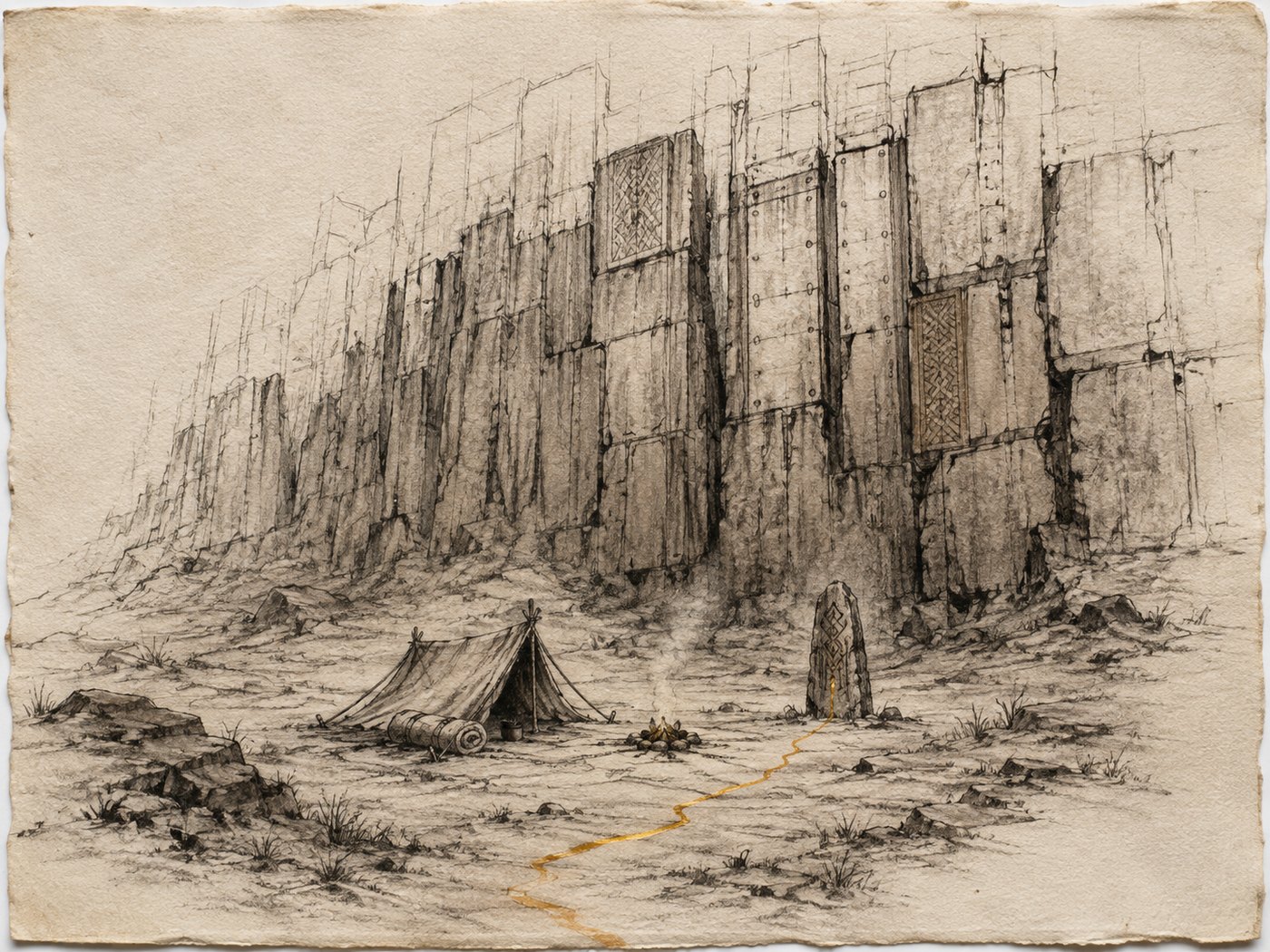
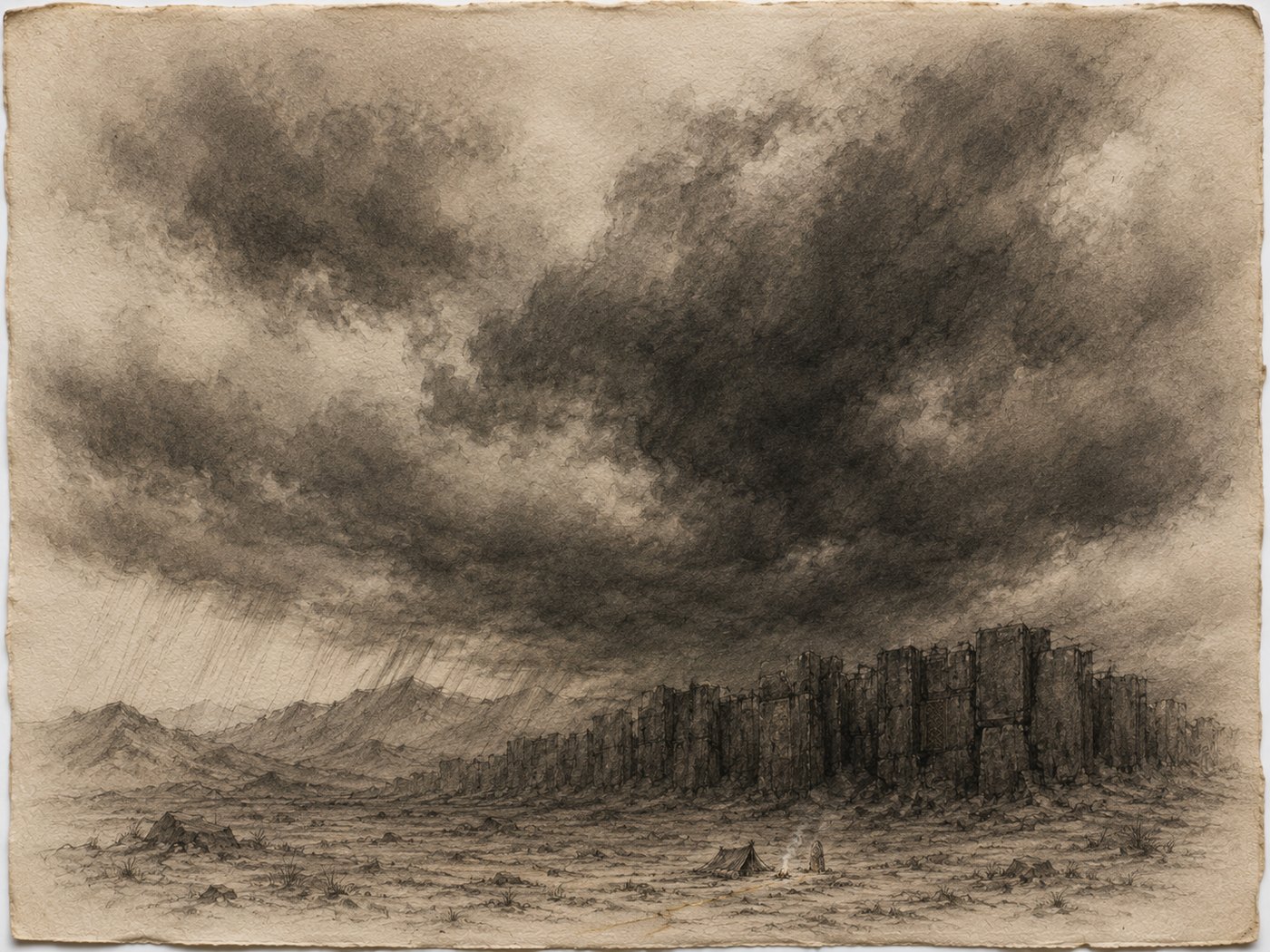
The wall is taller than the survey maps make it. Maps flatten what a thing means. From the tent it fills half the sky, and the stone at my knee — waist-high, carved with a spiral my grandmother would have known — marks the exact line where my welcome ends.
I pitched camp where they can watch everything I do: fire, food, mending, sleep. That is the whole plan. There is no other plan.
The Weave came with me as far as the stone, and stopped. It will not cross. Tonight its light lies along the path behind me like a thread laid down and not yet woven, and the wall stays dark, and somewhere behind it someone is watching me boil water.
Velta says you cannot push a thread into cloth. Presented, then. Held true. We will see about received.
First evening. The thread stops where it should.Kai's line: flat.
Evening 4Vakars ceturtais
Children first — that is how curiosity is rationed here. Small eyes in the gaps between the stones, gone the moment I look up. This evening I counted five. I mended my sock by the fire, slowly, the way Velta mends: so the watcher learns the hands.
At dusk an old man came up onto the wall and stood a long time. He did not look at my camp. He looked at the light on the path behind it, the way you look at weather.
Evening 9Vakars devītais
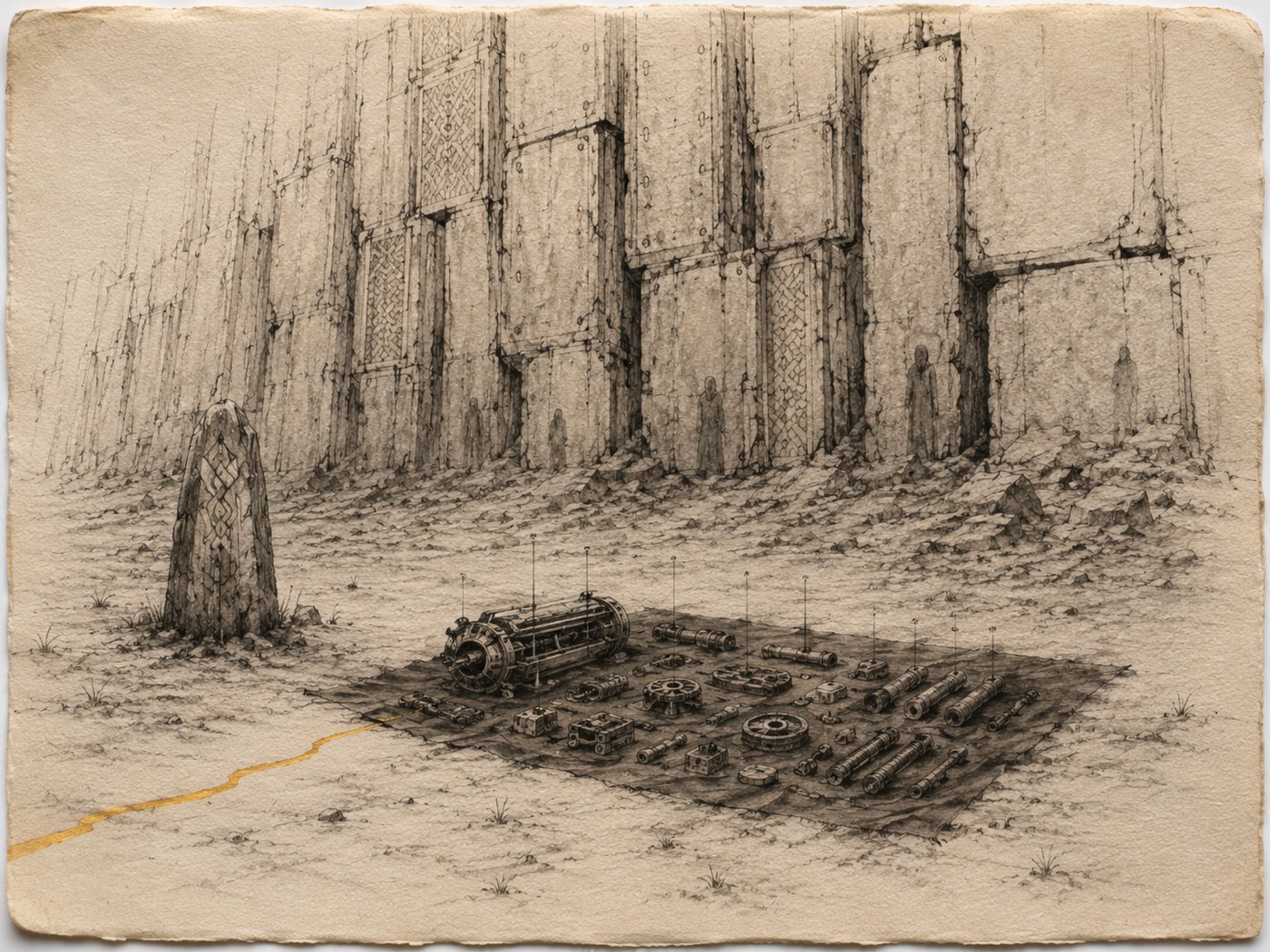
Today we carried the fabricator up — and took it apart. All of it, laid out in rows on dark cloth beside the stone: coils, shuttle, feed spools, the provenance threads hanging over each piece like heat over summer stone. Anyone may look, for as long as they like. Nothing asks to be believed.
A machine, opened, is a sentence anyone can read at their own speed.
Its twin stands beside it and works where they can see. This morning, a steel valve for a pump none of us has ever seen — we only know the reservoir up there is hand-kept, and hand-kept things break. This evening, bread.
Tomorrow we eat the bread ourselves, in full view. The first rule of offering: the maker eats first.
The opened machine. Every part where a doubt could reach it.
Evening 15Vakars piecpadsmitais
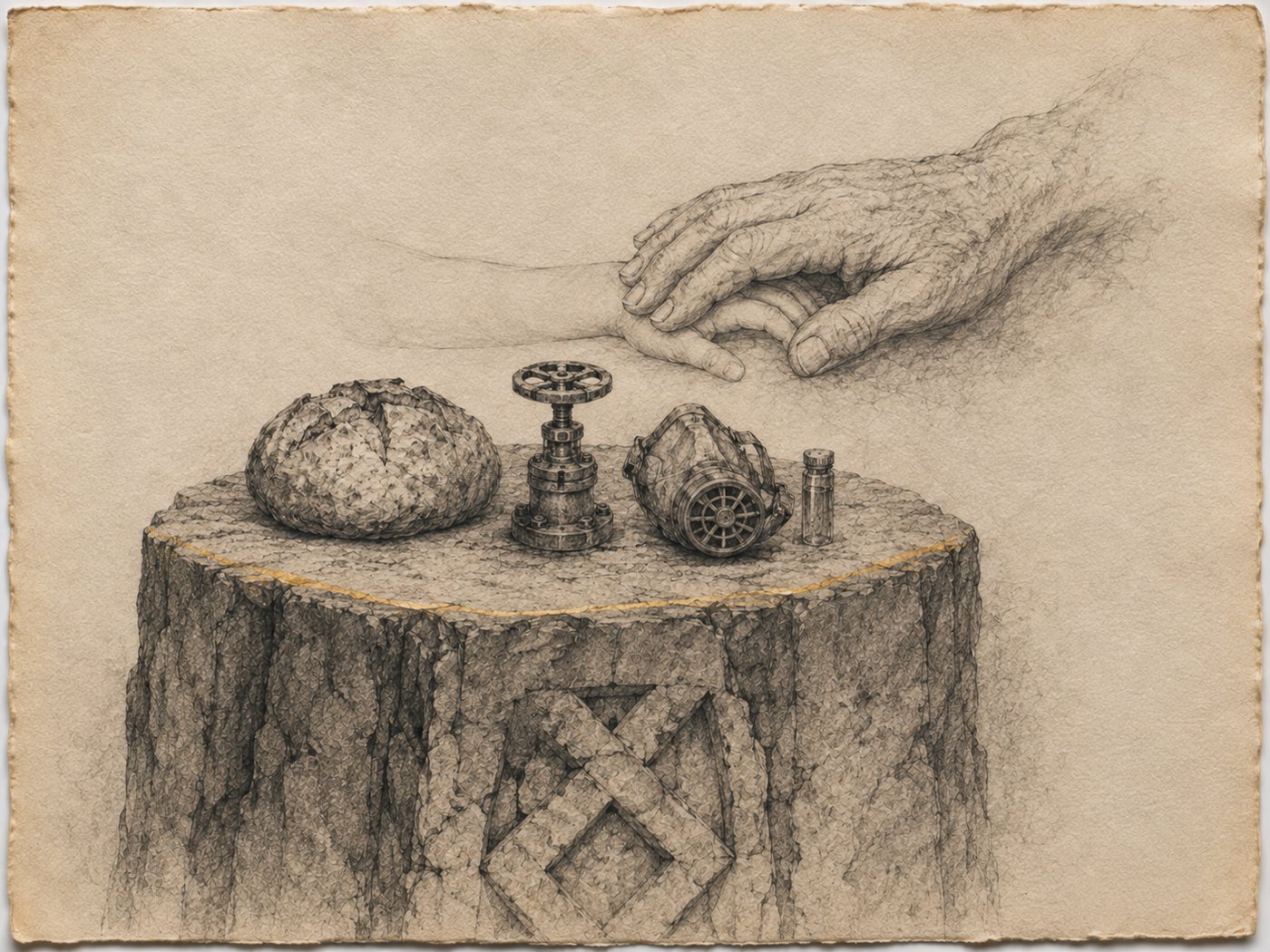
We ate first. Then I laid them on the stone in a row: the loaf, still warm. The valve. The little mask, child-sized, with its sealed vial. And we stepped back — ten slow paces, hands open — and stood.
A girl's hand came through the low gap in the wall. An elder's hand covered it, gently, and both withdrew. Nothing was taken.
I wrote nothing was taken and I am ashamed how long I sat looking at the sentence. Velta would read it the other way: the cloth felt the thread today. Felt it, and did not take it. That is not refusal. That is attention.
The offering, offered. The hands, both of them right.a tremor in Kai's line — under the threshold, he says.
Evening 22Vakars divdesmit otrais
Scouts now, by daylight — young men with good boots and rehearsed questions. Who paid for the machine. Who profits if the valley opens. What the outside did in the hunger year, and was it what their histories say.
The Clear Layer answered in the open air, with sources hanging where anyone could pull them, and twice the honest answer began: “Some of us were wrong. Here is the record of it.”
They came to catch us lying and caught us admitting. I watched that land harder than any bread.
Evening 31Vakars trīsdesmit pirmais
Tonight I stood at the wall and sang the boundary verse — the old one, the one that asks who are you, answer in rhyme, older than the wall and older than the abundance and older than every argument either side owns. My breath showed. No current anywhere in sight; I asked it to stay away. Just a woman singing at stones.
Kas tur klusē aiz akmeņa, Vai tur ļaudis, vai tur vēji? Es atnesu zelta diegu — Nāc, izaudi atbildiņu.
Who keeps silent behind the stone — are there people, or only winds? I have brought a golden thread; come, weave me a little answer.
The wall ate the verse whole. But silence has a texture when it is chosen, and this one was wool, not stone. I will sing again tomorrow.
Evening 33Vakars trīsdesmit trešais
She answered.
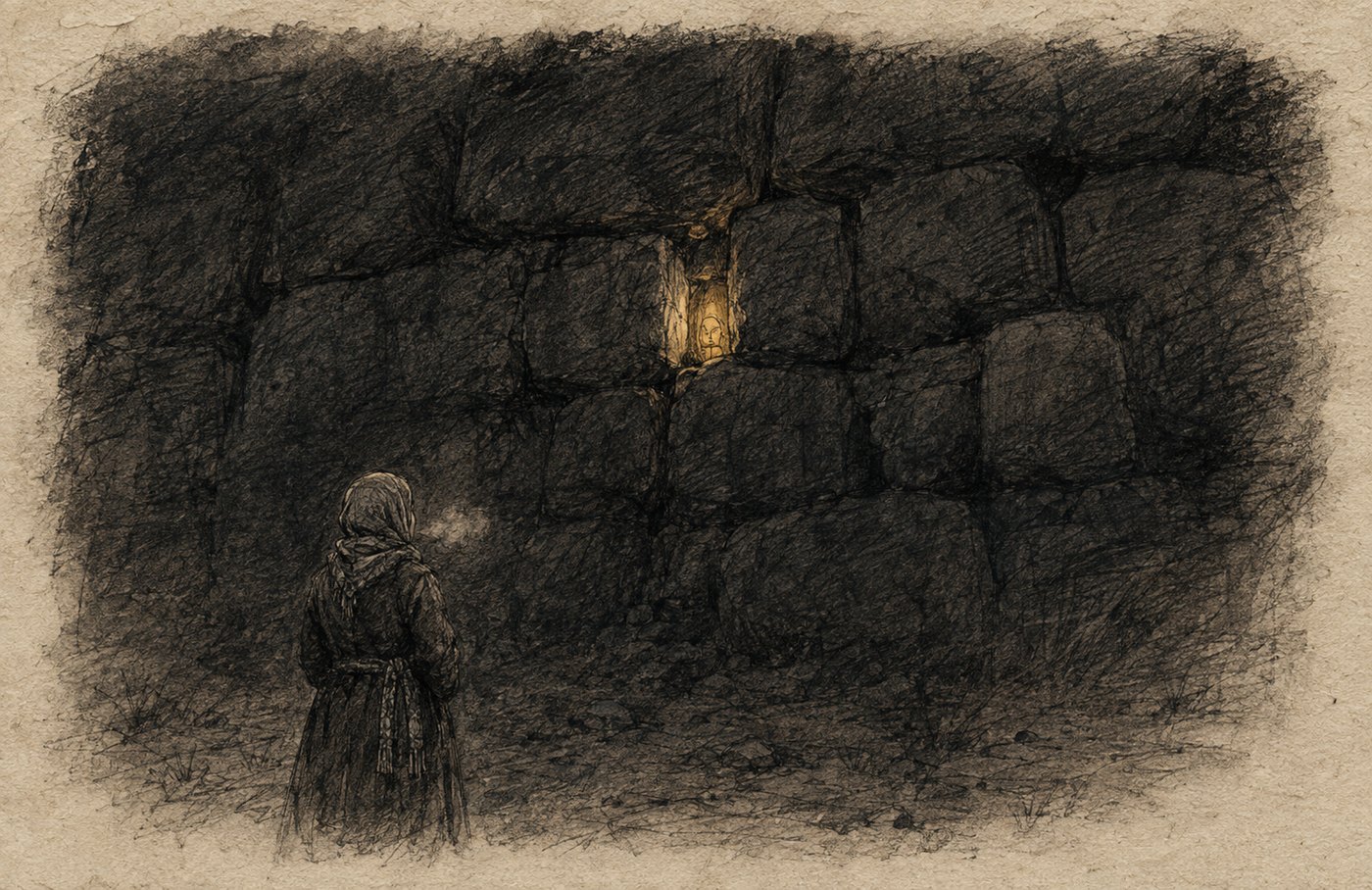
A child's voice, thin and exact, from a gap where lantern light stood behind the stones — the valley's own counter-rhyme, the one our grandmothers left them holding, kept alive forty years for exactly this use:
Nenes zeltu pie vārtiņiem — Zelts mūs reizi apmānīja. Ja tu taisnu diegu vērpi, Lai tas mūsu ziemu gaida.
Bring no gold to the little gate — gold deceived us once. If the thread you spin is straight, let it wait out our winter.
It is a refusal. It is also an instruction — wait, and be watchable while you wait — and you do not hand an instruction to someone you have decided is nothing.
I sang the assent verse back. Then I sat down on the ground by my fire and cried a little, quietly, so the wall would not see.
The gap in the wall, lit from the far side.
Zelta diegsthe call, and the answer
the line moved. first time in forty years.
Evening 40Vakars četrdesmitais
Every dusk now, the wall sings. Some evenings they begin; we answer; verse for verse, teasing and formal and binding — the whole boundary-song grammar intact behind forty years of stone. They kept all of it. Of course they kept all of it. It was never the songs they distrusted.
And at night, when the singing is done, a sound I did not understand at first: a hand pump, worked slow and steady, long past any need for water. The Weave says the aquifer on that side is sound. So it is not for water.
I have stopped asking it what things are for. Some threads you do not pull.
still climbing.
Evening 47Vakars četrdesmit septītais
He spoke against us tonight — the old man from the wall, in their meeting hall. We heard the shape of it even out here, the way you hear a storm through a floor.
And here is what I want this journal to remember: every fact in his sermon is true. The queues were real. The ledgers were real. The waiting was real, and what it cost him was real, and it is his, and I will not touch it.
Only the conclusion is wrong. A lie built entirely of true things. There is no cleaner work in all the dark crafts, and no argument against it — because the moment you argue with the facts, you lose, and you deserve to.
The wall did not sing tonight. Or last night.
falling.
Evening 52Vakars piecdesmit otrais
I asked the Weave, tonight, how they can ever tell patience from a predator's long game. It was quiet for a while — it is never computing when it is quiet; it is choosing — and then:
“From words, they cannot. The only proof of restraint is restraint. There is no shortcut. That is what makes it true.”
So: no shortcut. I wrote it at the top of the page so I stop asking. The bread goes on the stone tomorrow, the same hour. The verse gets sung, answered or not, the same hour. Patience must be boring to be legible — that is the whole craft. To be predictable the way sunrise is predictable, and as free of demands.
Evening 68Vakars sešdesmit astotais
A child's voice again at dusk — two verses, quickly, like something spilled before a door could close on it. Then men's voices, not singing.
We pretend not to keep score, and I keep score: the young ones climb the wall at night to listen to the music from the plains. He is not losing to me. He was never going to lose to me. He is losing to their own children.
I take no pride in that sentence. I take hope.
rising again. unevenly.
Evening 84Vakars astoņdesmit ceturtais
No proper singing for two weeks, and tonight the air is wrong — too warm, too heavy, the sky over the peaks the color of wet iron. Rain is coming, more of it than a hand-kept reservoir was ever built to hold.
The Weave has gone very quiet, the way it goes quiet when it is counting what it may soon be asked for. Along the path behind me the light is banked like dawn held behind a hill.
I keep thinking of a pump worked at night. Of a small mask on a stone, untaken. Whatever comes, we stay on this side of the line. It has to be them. It was always going to have to be them.